
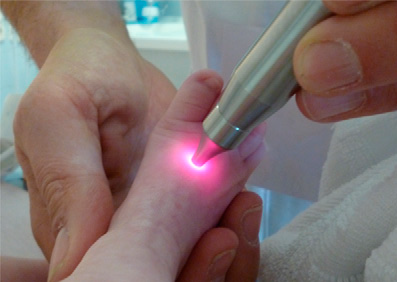
In clinical settings, supplementary near-infrared light applications and laser acupuncture have demonstrated marked efficacy, significantly reducing asthma severity grades, daytime and nighttime symptoms, and exacerbations, while establishing substantial improvements in asthma control and lung function.
Laser Acupuncture for Childhood Asthma: What Parents Should Know
By Dr. Jason Atkinson, DC | Chiropractic Physician and Medical Acupuncturist | Life Long Wellness | Evidence reviewed August 27, 2026
Quick Look: Laser acupuncture uses low-intensity light on selected acupuncture points without needles. Small pediatric studies suggest it may improve some asthma-control, lung-function, or inflammation measures when added to conventional care. It may be considered as an adjunct for stable asthma—not as a substitute for inhaled corticosteroids, a rescue inhaler, a written asthma action plan, or urgent medical care.
Why parents are asking about laser acupuncture
When a child coughs at night, sits out at recess, or reaches for a rescue inhaler before sports, parents naturally look for every safe way to help. Many are interested in laser acupuncture because it is needle-free, usually comfortable, and designed to stimulate acupuncture points with low-intensity light rather than puncturing the skin.
That interest is understandable. It is also important to separate three different questions: Is the treatment comfortable? Is there a plausible biological effect? And has it been proven to improve the outcomes that matter most—fewer attacks, better breathing, normal activity, less missed school, and safe medication use? The first answer is generally yes. The second is plausible. The third is promising but more comprehensive studies are warranted.
What is laser acupuncture?
Laser acupuncture—sometimes called low-level laser acupuncture or “cold laser” acupuncture—directs a low-intensity laser at specific acupuncture points. Unlike traditional acupuncture, no needle enters the skin. Depending on the device and settings, the light may be visible green or red or near-infrared.
Laser acupuncture overlaps with photobiomodulation (PBM), the broader use of low-intensity light to influence cellular activity. They are not identical terms. PBM may be applied over a tissue region, while laser acupuncture applies light according to an acupuncture-point strategy. Evidence about general PBM should not automatically be treated as proof that a particular laser-acupuncture protocol works for childhood asthma.
Proposed mechanisms include effects on cell energy signaling, oxidative stress, inflammatory mediators, immune-cell behavior, and neural reflexes. A 2026 critical review described plausible effects on type-2 inflammatory cytokines, eosinophil recruitment, mucus-producing cells, oxidative stress, and tissue remodeling. However, the authors also emphasized that dose, treatment geometry, tissue penetration, and delivery of light to deeper airways would benefit from more research. In other words, a plausible mechanism is a reason to study a treatment—not complete proof of the clinical benefits.
What does the research actually show?
The pediatric evidence is mixed. The most useful way to read it is as a progression: a few encouraging signals, several important limitations, and a clear need for larger, independent trials.
| Study and design | What it found | How to interpret it |
| 2002 | Gruber et al. Double-blind crossover RCT, n=44 | One laser-acupuncture session did not protect children from cold-air/exercise-induced bronchoconstriction. | A well-controlled result, but it tested only one session. It does not answer whether a treatment course has cumulative effects. |
| 2007 | Stockert et al. Double-blind pilot RCT, n=17 | Laser acupuncture plus a probiotic improved weekly peak-flow variability. | The sample was small (17 participants), and two treatment modalities were combined. |
| 2012 | Zhang et al. Systematic review, 3 RCTs, n=176 | These trials had mixed results; differences in patients, protocols, and outcomes prevented a complete meta-analysis. | The authors judged the evidence was too small for a firm conclusion. |
| 2013 | Elseify et al. Before-and-after study, n=50 | After 10 sessions, investigators reported fewer symptoms and improved spirometry and asthma-control scores. | No control group was used. A more complex study is needed. |
| 2017 | Dabbous et al. Sham-controlled pediatric trial, n=48 | After 12 sessions added to conventional therapy, 91.7% of the laser group versus 25% of controls improved asthma-control category; spirometry and exhaled nitric-oxide measures also improved. | Encouraging, but small, short-term, and single-center. Replication with standardized methods is needed. |
| 2024 | Al Sharkawy et al. Clinical study, n=50 | After 12 sessions over 5 weeks, investigators reported improved exercise tolerance, asthma-control and quality-of-life scores, fewer reported trigger-related exacerbations, and better FEV1. | Short follow-up. The abstract emphasizes before/after outcomes and gives limited comparator detail, so causal certainty is limited. |
| 2025 | Wang et al. Meta-analysis, 16 RCTs, n=1,675 | Across acupuncture-related therapies, some lung-function and inflammatory measures improved. | This review pooled several acupuncture modalities, not laser acupuncture alone. |
| 2026 | Bataduwaarachchi et al. Critical PBM review | Preclinical work suggests possible effects on type-2 inflammation, eosinophils, oxidative stress, mucus and tissue remodeling. | Photobiomodulation is broader than point-based laser acupuncture. Much of the evidence is preclinical. Dose, geometry, penetration, and long-term clinical efficacy require further study. |
Evidence summary based on the linked references at the end of this article. RCT = randomized controlled trial; PBM = photobiomodulation; FEV1 = forced expiratory volume in one second; FEV1/FVC = ratio of FEV1 to forced vital capacity.
The honest bottom line
Laser acupuncture for pediatric asthma is better described as promising than proven. A sham-controlled pediatric trial and several before-and-after studies reported improvements, but an earlier controlled single-session trial was negative. Laser-specific reviews have found too few consistent, high-quality trials for a firm conclusion. A broader 2025 meta-analysis of acupuncture-related pediatric treatments found possible improvements in some measures.
What this means for families: It can be reasonable to discuss a monitored trial of laser acupuncture for a child with diagnosed, stable asthma. It is always recommended that the pediatric clinician is informed so the case is co-managed.
Where laser acupuncture may fit
The safest clinical role is complementary: supporting a child’s overall asthma-management plan while the prescribing clinician remains responsible for diagnosis, medications, spirometry, and the written action plan.
A family may reasonably explore laser acupuncture when:
The child has a confirmed asthma diagnosis and is medically stable.
The parent has discussed complementary care with the pediatrician, family physician, allergist, or pulmonologist.
The child is fearful of needles or prefers a noninvasive treatment experience.
The family agrees in advance on measurable outcomes and a defined reassessment point.
Everyone understands that a laser visit is not emergency treatment and does not replace prescribed medication.
What should be measured?
A responsible integrative plan should be judged by outcomes, not by enthusiasm alone. Before the first visit, record a baseline and decide what would count as meaningful improvement. Depending on the child’s age and medical plan, useful measures can include:
Daytime symptom days and nighttime awakenings.
Use of the prescribed reliever, recorded exactly as directed in the asthma action plan.
Exercise tolerance and participation in school or sports.
Missed school days and activity limitations.
Asthma Control Test or Childhood Asthma Control Test scores, when age-appropriate.
Peak-flow or spirometry data obtained and interpreted by the child’s medical team.
Flare-ups requiring urgent care, oral corticosteroids, an emergency visit, or hospitalization.
Research protocols have often used approximately 10 to 12 sessions over several weeks, but there is no universally validated pediatric-asthma laser protocol. A clinic should not copy a study’s wavelength or dose without considering the exact device, beam area, point selection, patient characteristics, training, and safety requirements.
What a responsible consultation should look like
Review the child’s diagnosis, triggers, current symptoms, recent attacks, hospital visits, medication list, inhaler technique concerns, and written asthma action plan.
Confirm that the child is stable and that the family understands laser acupuncture is supportive care, not acute asthma care.
Establish a baseline using symptoms and objective information already available from the child’s medical team.
Explain the device, expected sensation, eye protection, proposed visit schedule, costs, and stop/reassessment criteria in plain language.
Share progress with the child’s medical clinician when the parent authorizes coordination. Any medication change should come from the prescribing clinician.
This approach protects the child and also makes the treatment more scientifically meaningful. If nothing important changes after an agreed trial, the plan should be reconsidered rather than continued indefinitely.
Is laser acupuncture safe for children?
Laser acupuncture is noninvasive and avoids needle-related bleeding or infection. Pediatric asthma trials have generally described it as well tolerated, but the published safety database is still small. “Low level” does not mean “no precautions.” Laser light can injure eyes, so wavelength-appropriate protective eyewear and trained operation are essential for the child, clinician, and anyone else in the treatment area. Parents should avoid do-it-yourself laser treatment or devices marketed with claims to replace medical asthma care.
Never use laser acupuncture for an asthma attack: Follow the child’s written asthma action plan and use prescribed reliever treatment exactly as directed. Seek emergency help for severe trouble breathing, inability to speak normally because of breathlessness, blue or gray lips/face, marked chest retractions, drowsiness or confusion, a “silent chest,” or symptoms that do not respond to the action plan. Call 911 when symptoms are severe or rapidly worsening.
Frequently asked questions
Can laser acupuncture cure childhood asthma?
No. Asthma is a chronic inflammatory airway disease. Current research does not show that laser acupuncture cures it. The appropriate question is whether it provides a measurable additional benefit for a particular child while guideline-based care continues.
Can my child stop an inhaler if laser acupuncture helps?
Not on the basis of a laser-acupuncture visit. The 2026 Global Initiative for Asthma guidance says children ages 6 to 11 should receive treatment that includes an inhaled corticosteroid. Medication should be adjusted only by the prescribing clinician after reviewing symptom control, risk, lung function when appropriate, and follow-up data. Never remove a rescue medicine from the child’s action plan without medical direction.
Does laser acupuncture hurt?
It is usually described as painless or gently warm, and no needles are used.
How many sessions are needed?
There is no established evidence-based schedule for pediatric asthma. Published studies have often used 10 to 12 sessions over several weeks, but protocols vary considerably depending on the patient, case history and comorbidity factors. A treatment plan should include a defined reassessment rather than an open-ended commitment.
Is laser acupuncture the same as red-light therapy?
No. Both may fall under photobiomodulation, but laser acupuncture uses an acupuncture-point strategy and specific device parameters. A consumer red-light panel is not equivalent to a clinical laser-acupuncture protocol.
Will insurance cover it?
Coverage varies by plan, provider type, diagnosis, and billing policy. Families should ask for an estimate and verify benefits directly with the insurer. Lack of coverage does not prove a treatment is ineffective, and coverage does not prove that it works.
A measured, family-centered way forward
Parents do not need hype; they need a clear view of what is known, what is uncertain, and how to protect their child while exploring additional options. Laser acupuncture is appealing because it is needle-free and biologically interesting. The available research contains encouraging signals, but is not a stand-alone standard pediatric-asthma treatment.
My clinical position is straightforward: keep the child’s medical asthma plan in place with open communication with the prescribing clinician, define objective goals, use appropriate laser safety, and judge the adjunct by results. That is how integrative care can remain both hopeful and responsible.
Considering a consultation? If your child has diagnosed, stable asthma and your family is exploring a needle-free adjunct, bring the current asthma action plan, medication list, recent lung-function results if available, and the contact information for the child’s medical clinician. A responsible consultation should coordinate with the child’s medical team, use appropriate laser eye protection, define measurable goals, and never present laser acupuncture as emergency asthma care. Learn more about Dr. Atkinson’s approach to medical acupuncture or request a consultation with Life Long Wellness at www.llwellness.com
About Dr. Jason Atkinson
Dr. Jason Atkinson, DC, is a chiropractic physician and medical acupuncturist with 27 years of clinical experience. At Life Long Wellness, he provides evidence-informed, patient-centered chiropractic and acupuncture care while emphasizing appropriate coordination with a patient’s medical team. Learn more at www.llwellness.com.
Medical and editorial disclaimer
This article is educational and does not diagnose or treat an individual child. Laser acupuncture is not a replacement for evaluation by a pediatric clinician, guideline-based asthma medication, a rescue inhaler, a written action plan, or emergency care. Evidence and guidelines change; this article reflects sources reviewed through August 27, 2026. Parents should discuss complementary care with the child’s physician, allergist, or pulmonologist.
References
1. Stockert K, et al. Laser acupuncture and probiotics in school age children with asthma: a randomized, placebo-controlled pilot study. Pediatr Allergy Immunol. 2007;18(2):160-166. PMID 17338790. PubMed
2. Bataduwaarachchi V, et al. Effects of Photobiomodulation on Asthma Immune Pathobiology: A Critical Review. Lasers Surg Med. Published online August 23, 2026. PMID 42633650. doi:10.1002/lsm.70193. Publisher / DOI
3. Gruber W, et al. Laser acupuncture in children and adolescents with exercise induced asthma. Thorax. 2002;57(3):222-225. PMID 11867825. PubMed
4. Zhang J, et al. Laser acupuncture for the treatment of asthma in children: a systematic review of randomized controlled trials. J Asthma. 2012;49(7):773-777. PMID 22873427. PubMed
5. Elseify MY, et al. Laser acupuncture in treatment of childhood bronchial asthma. J Complement Integr Med. 2013;10:199-203. PMID 23843569. PubMed
6. Dabbous OA, et al. Evaluation of the improvement effect of laser acupuncture biostimulation in asthmatic children by exhaled inflammatory biomarker level of nitric oxide. Lasers Med Sci. 2017;32(1):53-59. PMID 27709308. PubMed
7. Al Sharkawy AAA, et al. Role of stimulating combined visceral meridians by laser acupuncture on asthma exacerbation and quality of life of asthmatic patients. Egypt J Bronchol. 2024;18:99. Open-access article
8. Wang J, et al. Effectiveness and safety of acupuncture and related therapies for pediatric asthma: a systematic review and meta-analysis. Front Med. 2025;12:1626830. Open-access article
9. Global Initiative for Asthma. Summary Guide for Asthma Management and Prevention for adults, adolescents and children 6-11 years. Updated 2026. GINA 2026 report
10. National Heart, Lung, and Blood Institute. Asthma Treatment and Action Plan. NHLBI
11. National Center for Complementary and Integrative Health. Acupuncture: Effectiveness and Safety. NCCIH